The complete guide to natural language SQL for PostgreSQL
Stop writing complex JOINs and subqueries. Use AI to generate SQL from plain English — connect your PostgreSQL database and get answers instantly.
The complete guide to natural language SQL for PostgreSQL
You know the feeling: a manager asks "What's the month‑over‑month growth for our top 10 products?" and you spend ten minutes wrestling with LAG() and window functions. What if you could just ask that question and get the answer immediately?
How LLMs understand your PostgreSQL schema
Modern LLMs (GPT‑4, Claude 3.5, Gemini) are surprisingly good at translating natural language to SQL when they know your table structures. The secret is schema context – the AI needs to know your table names, column names, data types, and foreign keys.
A well‑designed text‑to‑SQL tool will:
- Automatically introspect your PostgreSQL schema (tables, columns, relationships, indexes)
- Build a compact prompt that fits within token limits
- Generate a first‑pass SQL query in valid PostgreSQL syntax
- Self-correct based on PostgreSQL error messages if the query fails
Real‑world example
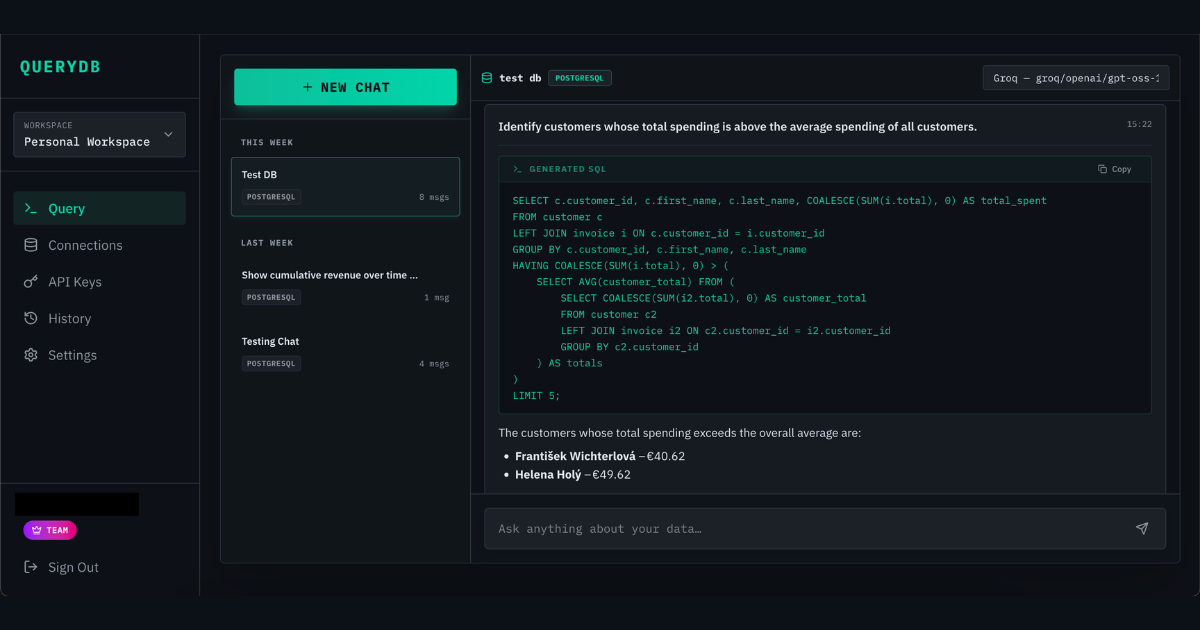
Question:
"List the top 5 customers by total purchase amount in 2025, including their email and phone."
Generated SQL (PostgreSQL):
SELECT c.name, c.email, c.phone, SUM(o.amount) AS total
FROM customers c
JOIN orders o ON c.id = o.customer_id
WHERE o.order_date BETWEEN '2025-01-01' AND '2025-12-31'
GROUP BY c.id, c.name, c.email, c.phone
ORDER BY total DESC
LIMIT 5;
No manual JOINs, no GROUP BY headaches. The AI handles it all. This is the future of self-service business intelligence on PostgreSQL.
Start today – bring your own key
Our tool never stores your PostgreSQL credentials or API keys on our servers. You enter them directly, and they are encrypted and used only for your current session. Total control, zero lock‑in. Whether you need to run ad‑hoc analytics or build a self‑service reporting layer on top of PostgreSQL, we've got you covered.
Check out our pricing for more details or read the documentation to learn how to connect your PostgreSQL database.